|
Note:
Current subscribers can click on the header above to log in,
if desired. The link to renew a subscription
or to check when it expires is near the bottom of this page.
The Reid Reviews article
index gives a listing of stories published to date.
For suggestions about how to get the most out of the site see our site tips.
Reid Reviews' normal business
hours are 9:00 AM - 5:00 PM EST Monday through Friday
(excluding holidays) and any problems with
subscriptions, responses to e-mail, etc. are normally handled
during those business hours. I am, however, sometimes away
photographing during those hours and
appreciate your patience if you need to wait for a response to
your e-mail. If subscribing, please be sure that the
full name you provide exactly matches the name on your PayPal
account.
On April 20 I
published a
full field and
studio test of
the Leica SL
35/2.0
Summicron ASPH
tested on the
Leica SL3 and
SL2.
On March 17 I
published a
studio
comparison
test of the
Leica SL2 and
SL3 that looks
at color
rendering,
performance at
various ISO
levels,
highlight
headroom and
other aspects.
On March 7 I
published my
review of the
Leica
SL3. It
is the first
in a new
series looking
at the SL3 and
several
L mount
lenses. Next
up will be a
studio
comparison
test of the
Leica SL2 and
SL3 that looks
at color
rendering,
performance at
various ISO
levels,
highlight
headroom and
more.
Following that
will be a full
review
of the Leica
SL 35/2.0
Summicron ASPH
compared to
the Sigma
35/1.4 DG DN
Art and a full
review of the
Sigma 24/1.4
DG DN Art.
There will
also be side
by side tests
of the SL2 and
SL3 with
various
rangefinder
lenses.
On February
21 I
published an
article that
looks at the
ways in which
digital
perspective
correction
changes the
way a picture
is rendered.
The source
cameras for
the test raw
files were the
Fuji GFX100 II
and the Leica
M11 Monochrom.
On February
20 I
published an
article about
my first
impressions of
a
pre-production
Fuji X100 VI.
On February
5 I
published
studio tests
that look at
the color
rendering, ISO
performance,
highlight
headroom
and estimated
native ISO of
Fuji GFX 100
II.
On January
31 I
published a
review of the
Fuji GFX100
II.
On January
10, 2024 I
published an
article that
looks at
Leica's
"Perspective
Control"
feature and
various
workflow
options for
using it. Next
up in this
series we'll
look at the
effects
of
digital
perspective
correction
interpolation
on resolution
(for the Fuji
GFX100 II and
Leica M11
Monochrom).
On December
13 I
published an
article that
looks at
optical vs.
digital
approaches to
dealing with
vantage point
and
perspective
challenges.
This is the
first article
in a series
about the Fuji
GFX 100 II and
Fujinon TS
lenses but its
core question
is why one
might choose
to use
tilt/shift
lenses at a
time when
digital
perspective
corrections
are widely
available.
On November
10 I
published
studio tests
that look at
the highlight
headroom and
estimated
native ISO
of the Fuji
X-T5 and X-T4.
On October
20 I
published a
full field and
studio test of
the Pentax HD
FA 43/1.9
Limited.
On September
27 I
published
Part Two of
my
review of the
Pentax K3 III
Monochrome.
On September
16 I
published
Part One of an
extensive
two-part
review of the
Pentax K3 III
Monochrome.
On August 9 I
published a
full field and
studio test of
the Pentax HD
FA 31/1.8
Limited.
On July 31 I
published an
article that
looks at how
the Leica M11M
and M10M
respond to
color filters
which
are used to
change
tonality.
On July 18 I
published
studio tests
that look at
the Leica Q3's
highlight
headroom and
estimated
native ISO.
On June 16 I published a studio comparison test of the Leica Q2 and Q3 which looks at color rendering
On June
1 I published an
article based
on studio
tests which
compare the
Leica Q2 and
Q3
in terms of
resolution,
vignetting and
color drift.
On May 25 I
published a
full field
review of the
Leica Q3. This
is the first
in a series of
articles
about the new
camera.
On May
17 I published an
article that
looks at the
highlight
headroom and
estimated
native ISO of
the Leica M11
Monochrom.
On May 12 I published an
article
covering side
by side studio
tests -- of
the M11M, M10M
and M11 --
that
look at
resolution and
vignetting
with a
challenging 21
mm and a
challenging 28
mm lens.
On April 14 I published an
article
covering side
by side studio
tests -- of
the M11M, M10M
and M11 --
which look at
spectral
sensitivity
and overall
rendering as
well as noise
at various ISO
levels
(and file
dimensions).
Next up will
be tests of
resolution and
vignetting,
for all three
cameras, with
four
rangefinder
lenses. In a
separate
article, I'll
also be
testing
highlight
headroom and
apparent
native ISO.
Other articles
in the series
will look at
high ISO
theater
photography
with the M11M
and
the camera's
tonal response
to external
color filters.
On April 13 I published a
full field
review of the
new Leica M11
Monochrom.
This is the
first in a
series
of articles
about the new
camera.
On March 29 I published a full field and studio
test review of the Canon 35/2.8 LTM
lens tested on the
Leica M10 Monochrom and M (Typ 240).
On March 16 I published an article which is part review
and part essay. It looks at the
performance
and rendering of the Canon 28/2.8, on the
Leica M10 Monochrom and Leica M (Typ 240),
in the context
of a larger discussion of lens drawing and
of this particular lens' influence on the
look of many photographs
made by Garry Winogrand.
On February 15 I published an essay about seeing and
focusing the subject with a rangefinder
camera.
On
February
3 I
published a very
extensive article based on side by side studio
tests of the Fuji X-T5
and X-T4. This is the first time that I have
done formal tests of Fuji's 40 MP APS-C sensor
and the
results were quite interesting.
On January 19 I
published a full review of
the Fujifilm XF 30/2.8 LM WR Macro based on field
and studio
tests done using the Fujifilm X-T5. Some of the
studio comparison tests were also done using a
Fujifilm
XF 33/1.4 as a reference lens.
On January 10,
2023 I
published my review of the
Fuji X-T5. I've simultaneously been working on two
companion articles which are coming up next. The
first is a review of the Fuji XF 30/2.8 Macro and
the
second is based on side-by-side studio tests of
the 40 MP X-T5 and 26 MP X-T4. Those tests will
look at
resolution, color rendering, noise at various ISO
levels and moire.
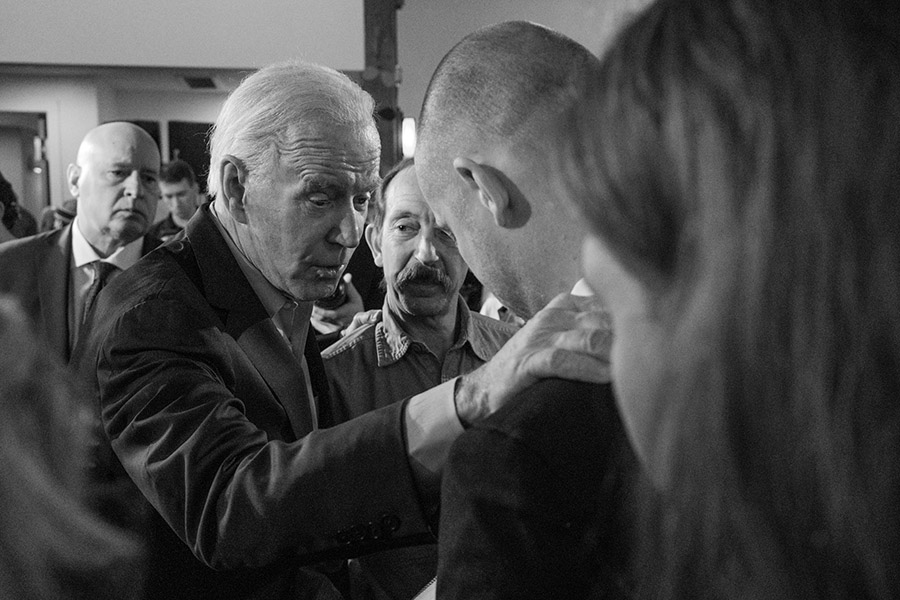
Every writer naturally brings his or her own
experience and perspective to the articles he or she
writes. My writing is heavily influenced by
my experience working as a professional photographer
for more than thirty-five years. I'm
primarily interested in cameras and lenses as tools
for drawing, as I believe that photography really is a
branch of drawing. As the photographer Henri
Cartier-Bresson once said in an interview, "My photography is just
an instant drawing...I never quit drawing. The
camera is a way of drawing." I'm also guided by the photographer Andre Kertesz's observation, "I see the thing, I feel the thing, I make the thing". So when I review a camera or a lens, I look primarily at how it presents the world to the photographer (via the finder), how it works as a tool in the hands, and how it draws the kind of picture we call a photograph.
"Quite simply, I think your sections on 'drawing' and and on 'sunny day lenses' are the best writing about photographic lenses that I have read - whether in magazines, journals, books or the various sources online. Few professional writers about photography ever attempt such a full consideration of the range of lens performance characteristics and the different ways in which they are photographically significant. Some discussions in photographic communities online circle around the subject, but don't achieve the focus, rigour and articulacy that you have managed here. Your article is what all writing about photographic lenses ought to be like, yet it's astonishing that next to none of it is. Interesting though Irwin Puts Leica lens book is, it would have been so much more interesting, and so much more appropriate to its subject matter, if it had been written as you have written here...I found the article incredibly useful and interesting. A great help in clarifying and firming up what I have experienced and half-understood about how different lenses work." - Simon
Pulman-Jones, England "We all owe you a vote of thanks for such a massive and thorough piece of work. What a concept-- a "lens test" that is really about the pictorial effect of how lenses draw their images. Lines per millimeter and MTF graphs have their place, but your article really gets to the heart of the matter in the way that photographers can relate to instantly." - Peter Klein, USA
- Jim Watts, USA

- Mikiro
Mori, Japan "...a very informative, even enlightening, work. It not only provides visual evidence of comparative lenses' performance, it also gets right to the most important factor of lens evaluation - how the image looks to the photographer. Long ago I stopped reading test charts of lenses since none of my clients ever published any. It is always the look of the finished image that counts." -
Richard Weisgrau, USA "I hope your tests become a benchmark for other reviewers to pay more attention to the real needs of photographers..." - Phil Fogle, USA
- Bill Marshall, USA
Example Articles ReidReviews.com accepts no advertising. A subscription is currently $49.95 per year. To get a sense of my writing style and approach you may want to read any of the freely accessible articles linked in the Read Without A Subscription section of our article index. And, of course, that index includes every article on RR so you'll be able to see just what content can be found here. As of late November, 2017 there were over 450 articles on the site, most of them quite extensive. All of them are reviews or essays.
Current Articles A list of current articles on Reid Reviews
can be found at the site's article
index.
Our Policy On Advertising
As many readers know, RR has always been an
independent site in many senses of that word. We hope
that our readers can appreciate the value of this
approach. As a society, we are barraged with
advertising (on the web, on televison, on radio, on
buses, streets, etc.). Reading Reid Reviews is, we
hope, an oasis from that. We have never accepted
advertising and we never will. We also have never
taken sales commission from any business. The Reid
Reviews system is simple: we create the content and
our readers, and only our readers, pay for it. For a humorous, but also very perceptive, take on where the line between journalism and advertising seems to be heading, for some publications at least, see this John Oliver video. I highly recommend watching it. Article Viewer Options
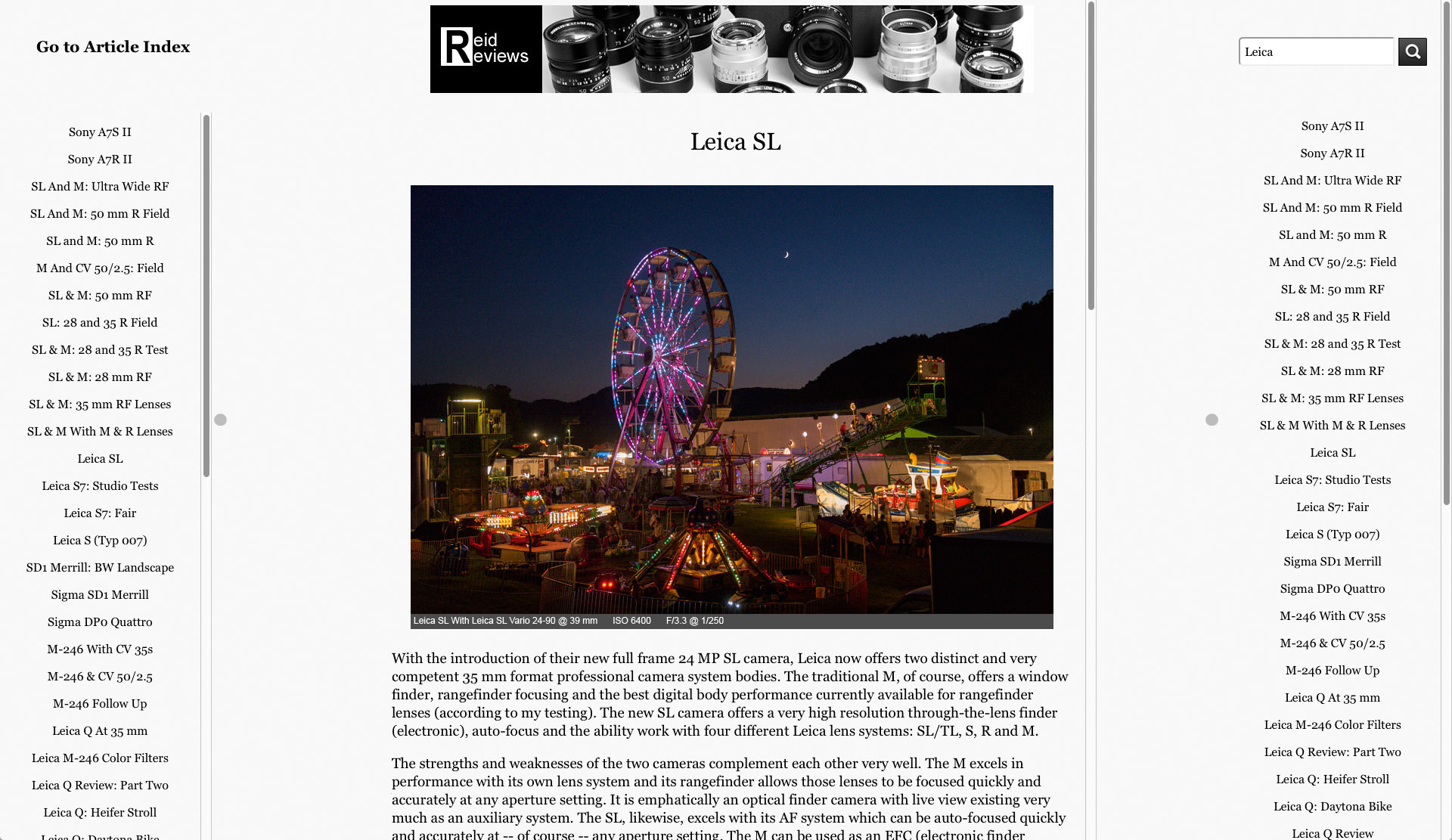
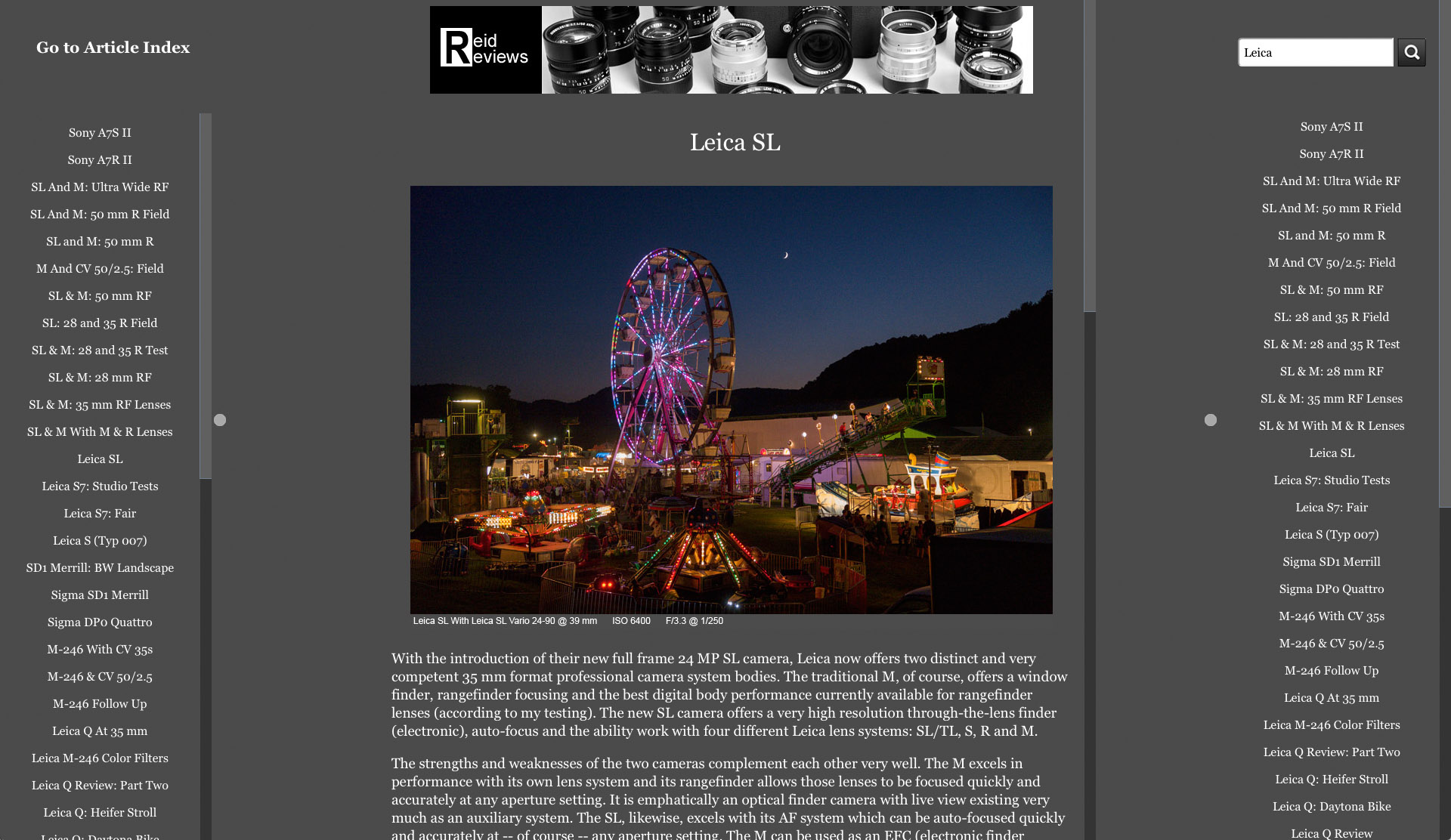
The new site offers six ways to view Reid Reviews content. Click the image below to read about these. 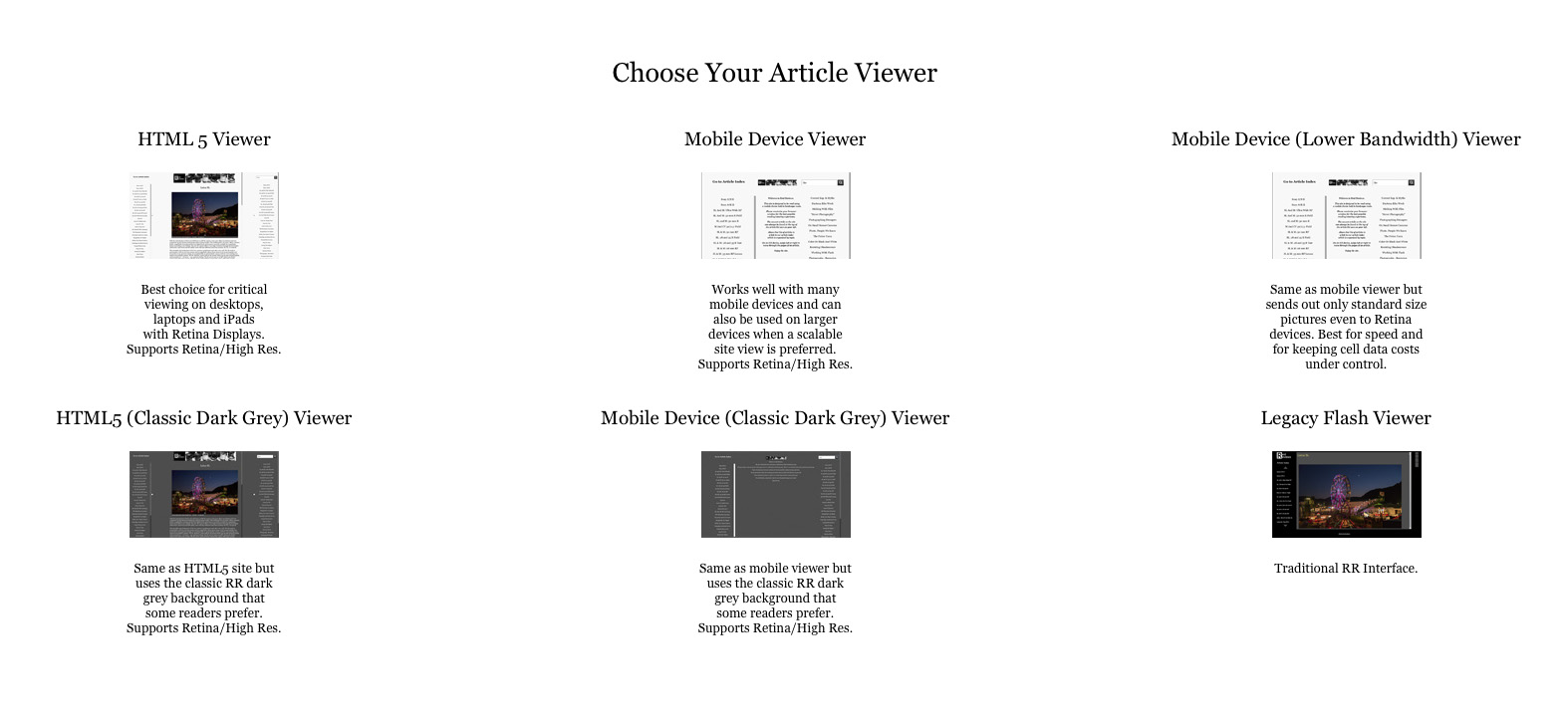
Article Viewers
Click on
either image below to get a sense of what our main
HTML 5 pages look like on a 1920 by 1200 pixel
monitor. Our mobile viewers are simplified and more
compact. The grey dots you see on each page are
clicked to open or close the side panels (an article
list panel on the left and a search panel on the
right).
Site Tips Useful tips on using the Reid Reviews site can be found here. That page is worth reading and will be updated from time to time.
Subscribing The one-year subscription rate for the site is $49.95. Once your username and password have been issued, the subscription amount is not refundable. The best way to sample my work (to decide if you'd want to be a subscriber) is to read the freely accessible articles linked in the Read Without A Subscription section of our article index. Pay Pal customers can pay for their subscriptions using their Pay Pal accounts and people who are not Pay Pal customers may make a one-time credit card payment to Reid Reviews via PayPal. To make a payment by check please follow the instructions listed on the "subscribe" page which is linked below. Reid Reviews' normal
business hours are 9:00 AM - 5:00 PM EST Monday
through Friday (excluding holidays) and any
problems with subscriptions, responses to e-mail, etc.
are normally handled during those business hours. I
am, however, sometimes away for medical appointments
during those hours and appreciate your patience if you
need to wait for a response to your e-mail. If
subscribing, please
be sure that the full name you provide exactly
matches the name on your PayPal account. If
they don't match there's a good chance the system will
not be able to start your subscription automatically. Reid Reviews is a high-bandwidth site full of high quality JPEGs that, intentionally, are saved with minimal compression so each picture file is quite large (given its dimensions). Preserving the thoroughness and technical picture quality of the reviews requires that the included JPEGs be only lightly compressed. When you choose your user name and password *please* record them in a safe place for future reference. If you misplace your user name or password please click on the "Log In" link and follow the instructions there. Paypal should automatically confirm your
payment so that your subscription begins immediately.
Due to the mysteries of PayPal, however, this
sometimes does not happen for a small percentage of
new subscriptions. The most common reason for
Paypal subscription problems is entering a
subscription account name that does not exactly match
the name one provides to PayPal. If you've
made a subscription payment but do not yet have
access to the site, please contact us to manually
confirm your subscription. I am a working
photographer, however, so I'm not always at the
computer and your patience is appreciated. That
said, I do my best to get accounts activated as
quickly as possible once I know that manual activation
is needed. When you subscribe, please enter your name exactly as it appears on your PayPal account (if you have one) or credit card (if paying without a Paypal account). Doing so can help to prevent problems with a subscription starting automatically. Name mismatches are the primary reason new subscriptions do not activate automatically. Again, if the name you enter for your subscription does not match the name on your PayPal account (or credit card) there's a very good chance that your subscription won't start automatically. If you have questions, please e-mail me.Subscribe Now Log-In (Remember, you can also always log in by clicking the header at the top of this page). Renew or check how long you have left on your subscription Our privacy policy can be found here. |